# Il protocollo SNAP
Descrizione del protocollo:
* [Protocollo](https://pi3g.com/2019/04/23/introduction-to-the-snap-protocol/)
Struttura del pacchetto:
 * SYNC: unique byte with the following structure: 01010100 (0x54), indicates the start of the packet
* HDB2, HDB1: The header definition bytes HDB2 and HDB1 define how long the packet will be, and which features will be used.
* DAB1: Destination Address Byte (0x12 per il PIC campione)
* SAB1: Source Address Byte (0x00 per il PC)
* DB1: Data Byte 1 – the payload for your application
* CRC2: high byte of CRC-16
* CRC1: low byte of CRC-16
Address 0 is reserved as a broadcast address and should not be used for anything else. (DAB / SAB)
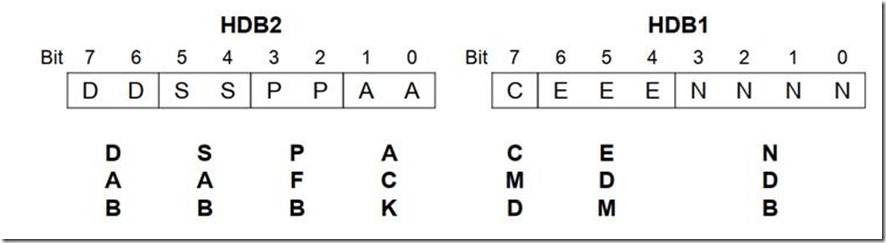
Nel caso di Valter abbiamo per HDB2
* DD=01 (Un byte di indirizzo destinazione)
* SS=01 (Un byte di indirizzo sorgente)
* PP=00 Non usato
* AA
* 00 = No Ack request (Tx)
* 01 = Ack request (Tx)
* 10 = Ack response (Rx)
* 11 = NAK response (Rx)
e per HDB1
* CMD=0
* EDM=error detection method 100 = 16 bit CRC.
* NDB=Numero di byte nel campo DB1
* SYNC: unique byte with the following structure: 01010100 (0x54), indicates the start of the packet
* HDB2, HDB1: The header definition bytes HDB2 and HDB1 define how long the packet will be, and which features will be used.
* DAB1: Destination Address Byte (0x12 per il PIC campione)
* SAB1: Source Address Byte (0x00 per il PC)
* DB1: Data Byte 1 – the payload for your application
* CRC2: high byte of CRC-16
* CRC1: low byte of CRC-16
Address 0 is reserved as a broadcast address and should not be used for anything else. (DAB / SAB)
Nel caso di Valter abbiamo per HDB2
* DD=01 (Un byte di indirizzo destinazione)
* SS=01 (Un byte di indirizzo sorgente)
* PP=00 Non usato
* AA
* 00 = No Ack request (Tx)
* 01 = Ack request (Tx)
* 10 = Ack response (Rx)
* 11 = NAK response (Rx)
e per HDB1
* CMD=0
* EDM=error detection method 100 = 16 bit CRC.
* NDB=Numero di byte nel campo DB1
 Trasmissione di una richiesta dall'applicativo di Valter
Da Master a Nodo slave
| 54 | 51 | 41 | 12 | 00 | 02 | 34 | C8 |
| SYNC | HDB2 | HDB1 | PC ADDR | PIC ADDR | PAYLOAD | CRC2 | CRC1 |
HDB2=0x51
1 byte di indirizzo destinazione
1 byte di indirizzo sorgente
Ack richiesto
HDB=0x41
1 byte dati
16 bit CRC
## Calcolo del CRC16
/ Online C compiler to run C program online
#include
void Crc16(unsigned short *crc, char c) {
int i,j;
for (i=0; i!=8; c>>=1, i++) {
j = (c^(*crc)) & 1;
(*crc)>>=1;
if (j) {
(*crc)^=0xa001;
}
}
}
unsigned char data[]={0x51,0x41,0x12,0x00,0x02};
int main() {
unsigned short crc=0x0;
for (int i=0;i<5;i++) {
Crc16(&crc,data[i]);
printf("0x%02x\n",data[i]);
}
// Write C code here
printf("0x%04x\n",crc);
return 0;
}
## Calcolo on-line del CRC-16
*
## Varie
* [Arduino SNAP Library](https://github.com/PHaroZ/arduino-snap)
* [ArduinoRS485 library]()
platformio.ini
lib_deps =
arduino-libraries/ArduinoRS485 @ ^1.0.2
## Prove RS485 fatte con ESP-32
ESP-32 e RS485
*
### Definizione Sercom0 RS485
In /home/pi/lora3a-boards/boards/lora3a-sensor1/include/periph_conf.h
aggiungere
{ /* Virtual COM Port */
.dev = &SERCOM0->USART,
.rx_pin = GPIO_PIN(PA, 5),
.tx_pin = GPIO_PIN(PA, 4),
#ifdef MODULE_PERIPH_UART_HW_FC
.rts_pin = GPIO_UNDEF,
.cts_pin = GPIO_UNDEF,
#endif
.mux = GPIO_MUX_C,
.rx_pad = UART_PAD_RX_1,
.tx_pad = UART_PAD_TX_0,
.flags = UART_FLAG_NONE,
.gclk_src = SAM0_GCLK_MAIN,
}
Trasmissione di una richiesta dall'applicativo di Valter
Da Master a Nodo slave
| 54 | 51 | 41 | 12 | 00 | 02 | 34 | C8 |
| SYNC | HDB2 | HDB1 | PC ADDR | PIC ADDR | PAYLOAD | CRC2 | CRC1 |
HDB2=0x51
1 byte di indirizzo destinazione
1 byte di indirizzo sorgente
Ack richiesto
HDB=0x41
1 byte dati
16 bit CRC
## Calcolo del CRC16
/ Online C compiler to run C program online
#include
void Crc16(unsigned short *crc, char c) {
int i,j;
for (i=0; i!=8; c>>=1, i++) {
j = (c^(*crc)) & 1;
(*crc)>>=1;
if (j) {
(*crc)^=0xa001;
}
}
}
unsigned char data[]={0x51,0x41,0x12,0x00,0x02};
int main() {
unsigned short crc=0x0;
for (int i=0;i<5;i++) {
Crc16(&crc,data[i]);
printf("0x%02x\n",data[i]);
}
// Write C code here
printf("0x%04x\n",crc);
return 0;
}
## Calcolo on-line del CRC-16
*
## Varie
* [Arduino SNAP Library](https://github.com/PHaroZ/arduino-snap)
* [ArduinoRS485 library]()
platformio.ini
lib_deps =
arduino-libraries/ArduinoRS485 @ ^1.0.2
## Prove RS485 fatte con ESP-32
ESP-32 e RS485
*
### Definizione Sercom0 RS485
In /home/pi/lora3a-boards/boards/lora3a-sensor1/include/periph_conf.h
aggiungere
{ /* Virtual COM Port */
.dev = &SERCOM0->USART,
.rx_pin = GPIO_PIN(PA, 5),
.tx_pin = GPIO_PIN(PA, 4),
#ifdef MODULE_PERIPH_UART_HW_FC
.rts_pin = GPIO_UNDEF,
.cts_pin = GPIO_UNDEF,
#endif
.mux = GPIO_MUX_C,
.rx_pad = UART_PAD_RX_1,
.tx_pad = UART_PAD_TX_0,
.flags = UART_FLAG_NONE,
.gclk_src = SAM0_GCLK_MAIN,
}