# FOX Board LX832 - Legacy Linux Embedded SBC
FOX Board LX832 is our legacy Linux embedded board still in production since 2006
OBSOLETE PRODUCT: This product is still available
just for the customers who are still using it their products and
do not need our support. Please note that we are not able
to provide technical support on this board.
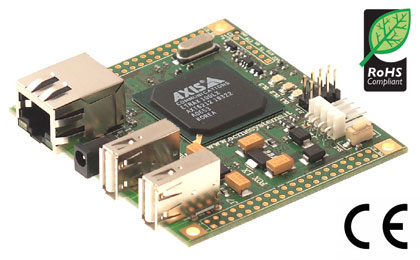
The FOX Board LX832
Zoom image
## Features
* Size: 66 x 72 mm (2.6 x 2.8 inches)
* Cpu: 100MIPS Axis ETRAX 100LX, 32 bit, RISC, 100MHz
* Memory: 8MB of FLASH, 32MB of RAM
* Power: Single power supply 5 Volt, 280mA (1 watt)
* Ports:
* 1 Ethernet (10/100 Mb/s)
* 2 USB 1.1
* 1 serial console port
* Extension signals with serial lines, parallel ports, GPIO lines, I2C bus interface
* Weight: 37 gr
* Temperature range: 0-70 °C
* Linux Kernel version 2.6.19
FOX Board runs a real Linux operating system (not a uC Linux) on an ETRAX 100LX microprocessor,
a 100MIPS RISC CPU made by Axis Communications.
Two USB 1.1 host interfaces can be connected to USB memory stick, hard disk, webcam, modem, Wi-Fi or Bluetooth dongle, ADSL adapter, Serial converter, etc.
Through the 10/100 ethernet interface it is possible to have access to the internal Web server, FTP server, SSH, Telnetd and the complete TCP/IP stack.
Two 40 pins sockets step 2.54mm (0.1") are available to plug the board on application specific carrier or add-on boards
(See: @h1='48'). On these pins are available a lot of signals as explained below.

Download a printable brochure.
Languages: English | Italian
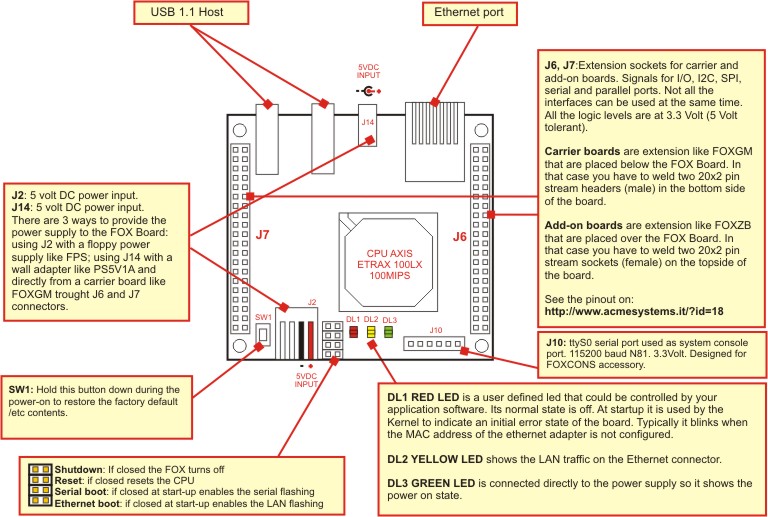
## Parts
 ## Extension sockets
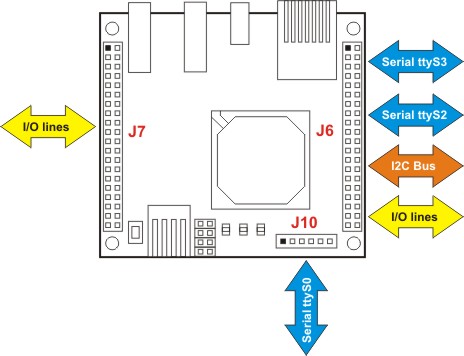
Extension socket lines
Default pinout configuration
On either side of the Fox board it is possible to solder
two 20x2 pin strip connectors step 2.54mm (0.1") to put the FOX Board over
an application board or move signals to another board using normal 40 pin flat cables.
A lot of peripherals can be connected to the FOX Board using these signals and hardware adapters when needed:
* Up to 48 general purpose I/O (**)
* Up to 3 asynch serial ports (**) (***)
* I2C bus
* Up to 2 parallel ports or 1 wide parallel port (**)
* Up to 4 IDE ports (8 peripherals) (**)
All the signal lines on the extension sockets need mechanical and/or electrical adapters to be used.
(*) With no usb or other devices connected
(**) Not all the signals on the extension sockets can be used at the same time. The peripheral signals configuration depends on Kernel setup and line assignments.
(***) The serial ports on Axis are four: 1 asynchronous port is already used as console (/dev/ttyS0) and it is not available on the extension sockets but only on the console connector J10; 1 other port (/dev/ttyS1) is in common with the USB1 port, the other 2 ports are completely available (/dev/tty2 and /dev/tty3). One of these can be configured also as RS485 or synchronous.
Be aware that the /mnt/flash directory is mounted on a FLASH memory that can only be written a finite number of times
(about 100K). Please don't save counters, logs or other frequently refreshed files in this directory but use /var
directory instead that is implemented in RAM memory. All the boards broken with this method usually can't be reflashed
and will be considered out of terms of warranty.
@include='pricelist_fox'